
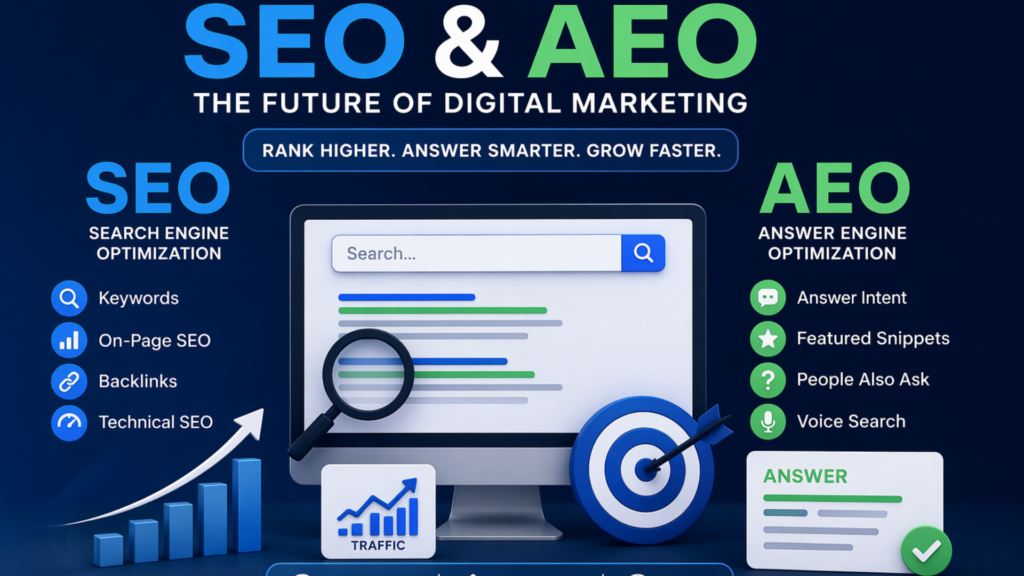
Search Engine Optimization (SEO) and Answer Engine Optimization (AEO), commonly referred to as SEO and AEO, are both strategies used to improve online visibility, and SEO and AEO are becoming essential in modern digital marketing. SEO and AEO focus on different outcomes, but SEO and AEO work together to improve how content is discovered and delivered. SEO is centered on optimizing content to rank higher on search engine results pages, while SEO and AEO ensure that content is both visible and optimized for answers.
In SEO and AEO, SEO drives organic traffic through keywords, backlinks, and technical improvements, while AEO focuses on providing direct answers. SEO and AEO are especially important for voice search and featured snippets, making SEO and AEO critical for AI-driven platforms. Businesses using SEO and AEO can improve both rankings and answer visibility through strong SEO and AEO strategies.
While SEO aims to attract clicks, AEO focuses on delivering instant value, and SEO and AEO together create a balanced approach. The integration of SEO and AEO ensures that users get both detailed content and quick answers. With the rise of AI, SEO and AEO are becoming more important for user engagement and satisfaction.
Together, SEO and AEO represent the evolution of search behavior. The future of digital marketing depends heavily on SEO and AEO, and businesses that prioritize SEO and AEO will gain a strong competitive advantage. Continuous optimization using SEO and AEO will ensure long-term success, making SEO and AEO a key foundation for growth.
What is SEO?
Search Engine Optimization (SEO) and Answer Engine Optimization (AEO) are processes used to improve a website’s visibility on search engines and answer-based platforms. The goal of SEO and AEO is to rank higher in organic (non-paid) search results and provide direct, accurate answers to user queries, thereby driving more traffic to a website. SEO and AEO involve several key components. Keyword research is one of the most important aspects, where marketers identify the terms and phrases users are searching for. These keywords are then strategically incorporated into content, titles, meta descriptions, and URLs.
On-page SEO focuses on optimizing individual pages, including headings, internal linking, and content quality, while AEO emphasizes structuring content to directly answer questions in a clear and concise manner. Off-page SEO involves building backlinks from reputable websites to improve domain authority, which also supports SEO and AEO performance. Technical SEO ensures that a website is easy for search engines to crawl and index, including improvements in site speed, mobile-friendliness, structured data, and secure connections (HTTPS).
Together, SEO and AEO help search engines and AI-driven platforms understand the relevance and quality of a website, ultimately determining its ranking and visibility.
What is AEO?

Answer Engine Optimization (AEO) is a more recent concept that focuses on optimizing content to provide direct answers to user queries. As part of SEO and AEO, the goal is not only to rank on search engine results pages but also to position content as the best possible answer for AI-powered systems such as voice assistants, smart devices, and AI chat interfaces.
SEO and AEO are closely tied to the way people interact with technology today. With the rise of voice search and conversational AI, users are increasingly asking questions in natural language rather than typing short keywords. For example, instead of searching for “best restaurants Kochi,” a user might ask, “What are the best restaurants in Kochi for seafood?”
To cater to this behavior, SEO and AEO emphasize clear, concise, and structured answers. Content must be designed to directly respond to specific questions, often using formats like FAQs, bullet points, and schema markup. Structured data plays a significant role in SEO and AEO, helping search engines and AI systems understand the context of the information provided.
SEO and AEO also focus on featured snippets, knowledge panels, and voice search results. When your content is optimized for SEO and AEO, it has a higher chance of being selected as the “single answer” delivered by an AI assistant.
Search Engine Optimization (SEO) is the practice of optimizing digital content so that it ranks higher on search engine results pages (SERPs). Within SEO and AEO, the primary goal is to increase organic (non-paid) traffic while also ensuring content is optimized for answer-based search experiences.
SEO and AEO involve multiple components, including keyword research, on-page optimization, technical improvements, and off-page strategies like link building. At the core of SEO and AEO is the understanding of how search engines work and aligning content with their ranking algorithms.
In today’s competitive digital environment, SEO and AEO are not just about ranking—they are about delivering value. High-ranking content must engage users, answer their queries effectively, and provide a seamless browsing experience across devices.
SEO vs AEO: Core Differences
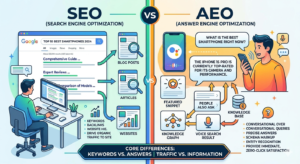
SEO and AEO differ in their goals, strategies, and outcomes, although they are closely related. Within SEO and AEO, SEO focuses on improving a website’s visibility and attracting users through higher rankings, while AEO focuses on delivering immediate answers without necessarily requiring a click. This shift highlights how SEO and AEO are evolving together to meet changing user expectations.
In terms of performance, SEO and AEO are measured differently. SEO success is often evaluated through metrics such as traffic, click-through rates, and keyword rankings. In contrast, AEO focuses on visibility in featured snippets, voice search results, and AI-generated responses. While SEO typically involves long-form, in-depth content, SEO and AEO together emphasize the importance of also providing short, precise answers that directly address user questions.
Another important aspect of SEO and AEO is content structure. SEO prioritizes well-optimized pages with proper headings, internal links, and keyword placement, while AEO requires content to be formatted in a way that is easy for AI systems to extract, such as FAQs, bullet points, and structured data. This makes SEO and AEO a complementary approach rather than separate strategies.
Despite these differences, SEO and AEO are not mutually exclusive. In fact, combining SEO and AEO strategies allows content to rank well in search engines while also serving as a reliable and direct source of answers for users. Businesses that effectively implement SEO and AEO can improve both their visibility and authority, gaining a competitive advantage in the digital landscape.
Why AEO is Gaining Importance

How to Optimize for SEO

Search Engine Optimization (SEO) is a fundamental strategy for improving your website’s visibility on search engines and attracting consistent organic traffic. In today’s competitive digital environment, SEO and AEO are essential, as simply creating content is not enough—you need to ensure that your content is discoverable, relevant, and valuable to both users and search engines. Optimizing for these strategies involves a combination of technical improvements, strategic keyword usage, high-quality content creation, and strong authority signals.
When done correctly, these approaches help your website rank higher on search engine results pages (SERPs) while also increasing your chances of providing direct answers to user queries. This enhances your ability to reach your target audience and achieve long-term growth.
In addition, these strategies focus on improving user experience by ensuring fast-loading pages, mobile responsiveness, and easy navigation. These factors not only support higher rankings but also encourage users to stay longer and engage more with your content. A strong user experience is a key element of success, as search engines prioritize websites that provide real value to users.
Another important aspect is content relevance and intent matching. Modern search algorithms are designed to understand what users are truly looking for, so your content must align closely with their needs. By creating content that answers specific questions and solves real problems, your strategy becomes more effective and impactful.
Furthermore, these methods emphasize the importance of building trust and authority. This includes earning high-quality backlinks, maintaining accurate and up-to-date information, and demonstrating expertise in your niche. Websites that consistently apply best practices are more likely to be recognized as reliable sources by both search engines and AI systems.
Finally, integrating SEO and AEO into your overall digital marketing strategy ensures long-term sustainability. As search engines continue to evolve with AI and machine learning, businesses that adopt these approaches will be better positioned to adapt, compete, and succeed in the future of search.
How to Optimize for AEO

Optimizing for AEO involves structuring your content in a way that makes it easy to extract and present as a direct answer. In SEO and AEO, this often means using question-based headings and providing clear, concise answers immediately after each question. This format improves readability and increases the chances of your content being selected for featured snippets and AI-generated responses.
Structured data also plays a crucial role in SEO and AEO. By using schema markup, you can help search engines understand the context and meaning of your content, increasing the likelihood that it will be featured in answer-based results. Proper implementation of structured data makes your content more accessible, organized, and machine-readable.
Another key strategy is writing in a conversational tone that reflects how people naturally speak. This is particularly important for voice search, where queries are often phrased as complete sentences or questions. By aligning content with natural language patterns, strategies become more effective in capturing user intent and delivering accurate answers.
Content formatting is also essential. Using bullet points, numbered lists, short paragraphs, and clear headings helps both users and search engines quickly understand your content. Well-structured content improves engagement and increases the likelihood of being selected as a direct answer.
Finally, building trust and authority is essential. Content that is accurate, well-researched, and backed by credible sources is more likely to be selected as the preferred answer. Consistently applying best practices helps establish your website as a reliable and authoritative source in your niche.
Additionally, these strategies benefit from regular content updates and optimization. Keeping information fresh, relevant, and aligned with current trends signals to search engines that your content remains valuable. By continuously refining your approach to SEO and AEO, you can maintain strong visibility, improve rankings, and secure long-term success in an evolving digital landscape.
.
Content Strategy for the Future

As the digital landscape continues to evolve, content strategies must adapt to incorporate SEO and AEO principles. This means creating content that is both comprehensive and easy to understand, providing value to users while also meeting the requirements of search engines and AI platforms. In today’s competitive environment, these strategies work together to ensure that content is not only discoverable but also capable of delivering precise, meaningful answers to user queries.
One effective approach is to use a hybrid structure that combines short, direct answers with more detailed explanations. This allows your content to serve multiple purposes, catering to users who want quick information as well as those who are looking for in-depth insights. By balancing depth and clarity, SEO and AEO strategies can improve both engagement and search visibility.
It is also important to consider multiple content formats, including text, voice, and visual elements. By diversifying your content, you can reach a wider audience and improve your chances of being featured in different types of search results. Multimedia integration enhances SEO and AEO by making content more engaging, interactive, and accessible across different platforms and devices.
Additionally, content organization and structure play a critical role in success. Using clear headings, subheadings, internal linking, and logical content flow makes it easier for both users and search engines to understand your content. Well-structured content improves readability and increases the likelihood of being selected as a featured answer.
Another important factor is intent-based optimization. Understanding user intent—whether informational, navigational, or transactional—helps you create highly relevant content that meets user needs. Aligning your content with search intent strengthens SEO and AEO performance and improves user satisfaction.
Furthermore, consistency and regular updates are essential for maintaining strong results. Search engines favor fresh, accurate, and updated content, so regularly reviewing and improving your pages ensures long-term visibility. Continuous optimization allows strategies to adapt to algorithm changes and evolving user behavior.
Finally, performance tracking and analytics are crucial in refining SEO and AEO strategies. Monitoring metrics such as engagement, impressions, and answer visibility helps identify what works and what needs improvement. By leveraging data-driven insights, SEO and AEO can be continuously optimized for better results and sustained growth.
Challenges of AEO

While AEO offers many benefits, it also presents certain challenges. In SEO and AEO, one of the main concerns is the potential reduction in website traffic, as users may find the information they need without clicking through to your site. This can impact key metrics such as page views and ad revenue, which have traditionally been central to performance.
Another challenge is the limited control over how your content is presented. AI platforms and search engines may modify, summarize, or rephrase your content, which can affect how your message is conveyed to users. This makes it essential for SEO and AEO strategies to prioritize clarity, accuracy, and strong content structure.
In addition, increasing competition is a growing concern. As more businesses adopt these strategies, ranking for both search results and answer-based features becomes more difficult. To succeed in SEO and AEO, brands must focus on high-quality, unique content and establish strong authority in their niche.
Another key challenge is maintaining content consistency across different platforms. Since content may appear in search results, voice assistants, and AI-generated answers, ensuring accuracy and consistency is critical for building trust. Effective SEO and AEO require regular content audits and updates to maintain reliability.
Despite these challenges, these strategies provide strong advantages. The increased visibility, credibility, and authority gained often outweigh the drawbacks. Businesses that successfully implement these methods can position themselves as trusted sources of information, even in zero-click environments.
Furthermore, these approaches open new opportunities for brand recognition. Even when users do not click through to a website, being featured as the primary answer helps reinforce brand authority and awareness. Over time, consistent visibility can lead to stronger audience trust and long-term engagement.
Ultimately, adapting to the evolving landscape of SEO and AEO allows businesses to stay competitive and future-ready. By balancing traffic goals with answer visibility, companies can build a more resilient and effective digital strategy.
Opportunities in AEO
AEO also presents significant opportunities for businesses and content creators. In the context of SEO and AEO, becoming a trusted source of answers helps establish your brand as an authority in your field. This can lead to increased credibility, stronger customer trust, and long-term success through effective strategies.
Early adoption of these strategies can provide a competitive advantage, allowing you to stay ahead of competitors who are still focused solely on traditional methods. Businesses that actively invest in SEO and AEO are more likely to gain visibility in voice search, AI-driven platforms, and featured snippets, making them essential for future growth.
Another major opportunity is enhanced brand visibility. Even without clicks, appearing in search results as a direct answer strengthens brand recognition. This makes these approaches not only a traffic strategy but also a powerful branding tool.
Additionally, SEO and AEO help businesses better align with user intent by delivering precise and relevant answers. This improves user experience and increases engagement, conversions, and loyalty.
Furthermore, these strategies support long-term digital success by adapting to changing search behavior. As AI continues to advance, SEO and AEO will play an even greater role in helping businesses stay competitive and relevant in the digital space.
Consistent implementation ensures sustained growth, improved authority, and better performance across platforms. The importance of these methods continues to increase as more platforms rely on AI, making them critical for long-term success.
Ultimately, SEO and AEO provide a strong foundation for future growth, helping businesses maintain visibility, build authority, and achieve lasting success in an AI-driven environment.
.
Future of Search: What to Expect

The future of search is likely to be shaped by continued advancements in AI and machine learning. As these technologies become more sophisticated, SEO and AEO will play a crucial role in helping search engines better understand user intent and deliver more personalized results. This evolution is transforming how search engines function, making these strategies a core part of modern digital approaches. Businesses that focus on these methods will gain better visibility and stronger positioning in AI-driven search results.
Voice search is expected to grow even further, making conversational content increasingly important. As users rely more on natural language, content must adapt to provide accurate, clear, and direct answers. This shift reinforces the importance of aligning content with real user behavior and expectations. With the rise of voice assistants, these techniques are becoming essential for capturing voice-based queries and delivering instant responses.
Additionally, the distinction between search engines and answer engines may continue to blur, creating new opportunities and challenges for marketers. Companies investing in SEO and AEO will be better positioned to dominate both traditional search and AI-driven platforms. The integration of these approaches ensures that content is not only discoverable but also selected as the best possible answer.
Ultimately, these strategies will define the future of search optimization in an AI-driven world. Consistent implementation of SEO and AEO will help businesses achieve long-term success, improve user engagement, and build strong authority.
SEO and AEO represent two critical aspects of modern digital marketing. While one focuses on visibility and traffic, the other emphasizes clarity and direct answers. Together, SEO and AEO create a powerful combination that helps businesses succeed in an increasingly competitive online landscape.
Conclusion
SEO and AEO represent two critical aspects of modern digital marketing. While SEO focuses on visibility and traffic, AEO emphasizes clarity and direct answers. Together, SEO and AEO create a powerful combination that helps businesses succeed in an increasingly competitive online landscape. The importance of these strategies continues to grow as digital platforms evolve, making SEO and AEO essential for modern marketing.
As user behavior continues to evolve, adapting to these strategies becomes essential. By embracing SEO and AEO, businesses can ensure their content remains relevant, accessible, and effective. The role of these approaches in improving user experience and delivering accurate information is becoming more significant, reinforcing their value in digital growth.
Furthermore, these methods help businesses improve both discoverability and answer visibility. With the rise of AI and voice search, they are becoming the foundation of successful content strategies. Companies that invest in these approaches will benefit from higher engagement, better authority, and a stronger online presence.
Ultimately, SEO and AEO will define the future of digital marketing. Continuous optimization ensures long-term success, improved rankings, and better user satisfaction in an AI-driven world.
Auth0er; MOHAMMED MUSTHAFA